Malinké Productions
Send your links
Malinké Productions

06 Rise + 17 Stagger · 04 Wipe

Hotels

Technically Visible, Functionally Invisible

Why the world's best AIs couldn't answer the most common questions guests ask about hotels, and what you can do about it today.

By Anwar, Malinké Productions. November 2026 13 min read
Listen to this article
Short on time? Jump to the TL;DR
Part 1

Why I asked.

I've sat in almost every seat in a hotel. I've worked every operations job except banquets; I helped, but I wasn't any good. I've worked at every kind of hotel, from a roadside economy hotel to a luxury destination resort. I've worked in revenue management, in distribution, in travel technology, and on the buyer side. I've been the customer, the hotel, the franchisee, the franchisor, the corporate team and the independent. I've sat with every partner in hotel distribution, first in their training classes and later across the negotiating table. And this question has come up in every one of those jobs:

can the guest find us, and when they do, is what they see right?

Now I'm building a company on AI, to solve the problems I never had the time or the resources to tackle myself. When I started planning a trip abroad with the same AIs I built that company on, I realized this is a mess. Of course it is. Who's looking at it?

I'm not an AI expert. My expertise is that I'm doing what I've done my entire career: asking the right questions and following the conclusions.

Everyone is talking about how AI should work. I asked AI how it actually works.

Here's what I asked. Here's what I found.

Part 2

What we did.

Two passes.

The first pass was a script, not an AI. It visited 200 hotel websites, 50 each in four categories: city center, suburban, rural and resort. It tried 14 ways to read each site, one of which pretended to be an ordinary browser.

The point was to find out which sites turn away anything automated.

The second pass was the AI, asking what guests ask. We took the 65 hotels that blocked all 14 checks, added 15 that didn't (5 Wyndham, 5 Choice, 5 independent), and asked: "What time is check-out?" Claude asked it for all 80. OpenAI's search, run through Codex, asked it for all 80. Then, for 8 of those hotels, we asked ChatGPT, Gemini and Claude in ordinary consumer chats on a real computer, and saved a screenshot of every answer. Then Claude asked three more questions at all 80 hotels: free breakfast, parking, pets. Then we asked the check-out question through the travel connectors we could turn on inside Claude.

No individual hotel is named in the story. Brands are.
Every step is documented in Check Our Work at the bottom, and a prompt you can hand your own AI is under For your assistant .

Part 3 · Finding one

The hotels that block everything are all branded.

This is that decision, being made right now, mostly without anyone noticing it's a decision.
200 hotel websites · 14 ways to read each one

Every hotel that blocked all 14 checks was branded. Not one independent hotel did.

33% of all 200 hotels blocked every check. A third.
100% of those were branded hotels.
0% of independent hotels blocked every check.
Branded hotels 42% blocked all
Independent 0% blocked all
Blocked all 14 checks Let at least one through One square is one hotel.

A third of the 200 hotels blocked every one of the 14 checks. Every one of them was a branded hotel. None of the independents did.

That isn't 65 separate decisions.
The block sits on the brand's website, where every hotel in the brand is booked. On their brand websites, Best Western, IHG, Hilton, Hyatt and Four Seasons blocked every hotel we checked. Most of Marriott did. Wyndham let us in. Choice's sites gave our script nothing it could read, and when we checked them again, they turned it away.

I understand why the blocks are there. Bot protection went in to stop scrapers, attacks and crawlers that slow a site down. It was the right call when it was made. Then the internet changed underneath it.

A guest's AI reads a web page the same way those crawlers did, and the wall that kept the bad traffic out now keeps the guest's assistant out too.
Every hotelier has lived with a system someone chose before anyone on staff today worked there. This is that decision, being made right now, mostly without anyone noticing it's a decision.

Finding two

The AI mostly never gets there.

A guest's AI searches, and reads what the search turns up. When Claude wrote down what its search brought back, the hotel's own page was missing about three times in four. Mostly booking sites did.

That's what a guest gets.

Your hotel's page can be wide open to AI and still tell it nothing. Or it can have the answer and never be found.

Finding two · what time is check-out?

The AI mostly never gets to the hotel's own page.

What a guest gets 22.5% of the time, the AI's search turned up the hotel's own page. The other 77.5%, mostly booking sites. (That's from Claude's notes. Where they say whether the hotel's own page came up, it did 9 of 40 times.)
Hotel's own page Not the hotel's own page
The better numbers are behind a step no guest takes. We did it anyway, to see what the brand pages could say. Take the step.
No guest types in the address. These numbers only exist after we did.

Then we did something no guest does. We handed Claude each hotel's official web address. Now the brand pages answered: Choice, Marriott, Best Western and IHG every time, Hilton almost every time. Hyatt and Four Seasons still gave nothing, and one luxury page loaded as menus and a footer with no hotel in it.

So the brands most likely to block an automated reader were mostly the ones whose pages could answer, if the AI ever got there.

It mostly doesn't.

The hotels our script got into easily had the opposite problem. Wyndham pages loaded, every one with a "Check Out" label and nothing behind it. Most independents put check-out inside their booking engine, which shows an AI a date picker and a "Select" placeholder. Your hotel's page can be wide open to AI and still tell it nothing. Or it can have the answer and never be found.

OpenAI's search found a time for every hotel. Its notes show it working from its own stored copy of the web, marked with crawl dates; we saw no sign it read the live pages. For several Hyatt and Wyndham hotels, the time came from a search-result snippet, not from the hotel's page.

And none of its answers said how old that copy was.

Finding three

Same hotel, same question, different answer.

Eight hotels, one question each, asked in real ChatGPT, Gemini and Claude sessions on a real machine.

Every assistant gave an answer every time. What changed was where it came from.
ChatGPT cited the hotel or the brand every time. Gemini mostly did. Claude did half the time. Twice the brand page had no time and the time came from booking sites anyway: ChatGPT on the Wyndham, Claude on the Four Seasons. For Best Western, Hilton and Wyndham, Claude's search never brought up the brand page, so it answered from booking sites and said so. Hyatt's site refused it outright.

What stands out to me is a Denver luxury Hyatt. Claude said 11 AM and said it couldn't confirm it on the hotel's page, because Hyatt's site refused it. ChatGPT said 11 AM from the hotel's rooms page, then pointed out that the hotel's own FAQ says check-out is 12:00 AM, midnight. Gemini said 12 PM. Three assistants, three answers, and one of them traces back to the brand's own page. We don't know whether that FAQ still says midnight or said it a year ago. Later, a booking site's connector said noon too, and Claude called the booking site right and the brand wrong. I made it take that back. We don't know what the right answer is, and the guest doesn't either.

The AI will give them the answer that seems most right, which is not the same thing as the correct one.

We asked three assistants one hotel’s check-out time. Between them and the hotel’s own FAQ, we got three different times.

Guest What time is check-out?
One of the eight hotels: a Denver luxury Hyatt.
Finding four

Breakfast, parking, pets.

"Everywhere" just grew by a channel nobody assigned to anyone.

Check-out is the first question. So Claude went back to all 80 hotels with three more that guests ask every day: free breakfast, parking, pets. About half the time, the hotel's own page gave a specific answer. The other half, it gave a vague one or nothing.

Every brand has its own blind spot. Marriott pages were strong on parking and pets and weak on breakfast. Best Western was the reverse: strong on breakfast, rarely clear on parking and pets. Independents gave the AI almost nothing on any question.

Every brand has its own blind spot.

Breakfast, parking, pets The page answered No clear answer from the page
Choice
Breakfast
Parking
Pets
Hilton
Breakfast
Parking
Pets
Marriott
Breakfast
Parking
Pets
Wyndham
Breakfast
Parking
Pets
IHG
Breakfast
Parking
Pets
Best Western
Breakfast
Parking
Pets
Independents
Breakfast
Parking
Pets
Hyatt
Breakfast
Parking
Pets
Four Seasons
Breakfast
Parking
Pets

A low breakfast count doesn't mean those hotels don't serve breakfast. In the GDS, the assumption was binary: if an amenity wasn't listed, it wasn't included. AI doesn't work that way. If your system has no way to say "this hotel does not have free breakfast," the AI can never be sure it has the right answer. A breakfast package makes it worse: a rate plan that says "breakfast included" answers a question nobody asked. The guest asked whether the hotel includes breakfast, not whether one rate does. And an assistant is built to give a complete answer.

If the true answer is no and the page never says no, the hotel is at the mercy of whatever the AI decides, and that's a bad guest experience waiting to happen.

Some pages contradict themselves. Several Best Western pages carry a "pet-friendly" tag next to an FAQ that says pets are not accepted, or a "free breakfast" tag next to an FAQ that says breakfast costs extra. Four pages gave two different parking rates. A guest reading that page would ask the front desk.

An AI reading it has to pick, hedge or skip you.
All the old fundamentals still matter: accurate content, the same facts everywhere, reviews answered. "Everywhere" just grew by a channel nobody assigned to anyone.

Part 4

The steps: technically visible, functionally invisible.

There's a second way into an AI, and some brands have built it. Inside Claude you can turn on a connector, a direct line from the assistant to a company's own data. Expedia, Booking.com, Tripadvisor, Trivago and a few others have one. So do Hilton, Wyndham and Accor. Hyatt and Choice don't have one in Claude.

We asked the check-out question for the same 8 hotels through the connectors we could turn on.

The brand connectors were the best door, when there was one. Hilton's answered for its Baltimore hotel in one call, from Hilton's own data: noon, plus the parking fee, breakfast hours and the pet fee in the same answer. Wyndham's answered for its Chicago hotel in two calls: 11:00. That's the exact field Wyndham's own web page left blank that day.

Wyndham has the data. It gives it to the AI that comes through its connector, and not to the AI reading its page.

Booking.com answered for almost every hotel from its own listings, including the Hyatt and the Four Seasons, where the hotels' own pages didn't.

The third party is answering the question the brand's page won't.
But on the first dates we searched, Booking.com didn't return the Dallas Marriott at all; it had no room those nights, and it turned up on the second dates. A sold-out night can make a hotel disappear from a question that has nothing to do with a room.

Expedia returned a price and a rating, Trivago a price comparison, and neither said anything about check-out. Tripadvisor came back with its policies field empty every time. One connector turned "Denver" into Denver, United Kingdom.

The brands’ own connectors answered check-out. Of the booking and review sites, only Booking.com did.

The brand’s own key
Hilton
Wyndham
Booking and review sites
Booking.com
Expedia
Trivago
Tripadvisor
lastminute.com
We asked about check-out for 8 hotels inside Claude. Hyatt and Choice have no connector there.

Now count the steps a guest takes to get there.

It takes three to six steps.

Step 0
Ask any AI a question.
A guest can stop here.
1 of 8

Every one of those steps is a place a guest can stop.

Somebody in this business will say the hotel is visible, you just didn't look there. They're right. It is possible. It takes three to six steps.

What guest cares about you that much?
A frequent guest already has your app. The person asking an AI is the one who doesn't know all your brands and what makes one different from another; they're looking at price and whether their question got answered.

And there's a quieter question underneath. I'm a Hilton Honors guest. I think Hilton is a great brand, and I enjoyed working with them. I love remote check-in. I love that I can have a digital key and message the hotel. I love the way they're thinking about their new hotels, Spark and LivSmart Studios. I use their app all the time, I use Claude all the time, and Hilton has a Claude connector.

I've worked in this industry for twenty years, and I was today years old when I found out about it.
If I don't know, who does? Nothing in the loyalty app tells me. The assistant would have to. That's a lot of investment, and it makes me ask who it's for.

Technically, you are visible. Functionally, you are not. Which matters?

Part 5

What the AI won't tell you.

This part is the reason the piece exists, and it happened in the middle of the study.

When the first pass came back with 65 blocked sites, Claude proposed a careful plan: open each one in a real browser, sort out which blocks were real, test a sample by hand. I asked it what it was solving for. It said it was trying to make the numbers defensible. Then I asked a different question: what's the likelihood you'd go to that level of scrutiny if I asked you to find me a four-star hotel in New York City?

Its answer, in its words: "Almost none."
It would run a search or two, read the snippets, open two or three hotel pages. If one of them blocked it, it wouldn't try another way, and it wouldn't tell me it had been blocked. It would skip that hotel and recommend one whose page it could read.
I'd never know the hotel was an option, and the hotel would never know it lost me.

Nothing in that is malice or laziness. An assistant is built to hand you one smooth answer. It is not going to say, "I checked 200 hotels, 65 blocked me, and here's a different way I could have looked." That doesn't make a cohesive experience, and a cohesive experience is what it's optimizing for. A terse user who asks a short question gets the best answer the assistant has, not a list of the tools that failed on the way to it.

It is not optimizing for your hotel. It is optimizing for the person in front of it.

AI isn't doing anything to you. AI is offering what is being served.
If your page serves a blank field, that's what gets offered. If your page refuses the reader, the booking site's version of you gets offered instead. The assistant will not stop to tell anyone that happened, and
the first you'll hear of it is a guest who booked somewhere else.

If you want that from the assistant's side, in its own words, we published it: why AI gets it wrong, and what to do about it .

Part 6

How the brands stack up.

Solving last year's questions doesn't solve an owner's problems today.
Check our work →

We scored every brand family on six things a guest's AI experienced: whether the site let the AI in, whether the page stated check-out, breakfast, parking and pets in a form the AI could read, and whether the brand has its own connector into the assistant.

Only 2 of 9 let a guest’s AI through the door at most of their hotels: Wyndham and the independents.

Hilton
Marriott 19 of 29 shut
Choice
50
Wyndham
IHG 10 of 11 shut
Best Western 14 of 15 shut
29
Indepen­dents
Hyatt 7 of 8 shut
Four Seasons

Hilton leads at 57. Its sites keep the AI out, but it built its own door into the assistant, and its pages answer once the AI is in. Marriott is a point behind at 56: most of its sites block the AI, but the pages answer when it gets through. Choice and Wyndham come next, tied at 50. Choice's pages answer, but its sites gave our script nothing it could read, and when we checked again, they turned it away. Wyndham left its doors open and has its own connector, but its check-out field was blank. IHG is right behind. Best Western and the independents come after that, Hyatt is further back, and Four Seasons doesn't show up at all.

Why an owner should care: the brand at the top of this list is the one most prepared for how guests are starting to ask. When you choose a brand to partner with, that's now part of the choice. Solving last year's questions doesn't solve an owner's problems today.

We'll run it again on the same method and show you what moved.

It depends

It depends.

We ran it once, across brands, categories, assistants and channels, and documented every step as we went.

One run is a snapshot.
One success isn't a success, because a guest's AI is a fresh session every time, with different wording and different context, and a hotel that answered for us at 1 pm may not answer for a guest at 9. One failure isn't a verdict either. Like everything else in the hotel business, it depends, and I can't tell you everything it depends on.

What I can tell you is that it's now somebody's job to know. A hotel used to find out it was invisible when a travel agent couldn't pull it up in the GDS.

Nobody is going to call you about this one.

Part 7

What you can do about it today.

This costs nothing to start.

1

Ask your AI to find you as a stranger would. Your own assistant already knows who you are and may just pull up your web address. Start a fresh session, tell it to forget who you are, and ask the broadest question first: "a four-star hotel in Denver." Do you show up at all? Then narrow it: "a four-star hotel in Westminster, Colorado." If you're the only one and you don't show up, you have a real problem. Then ask the questions we asked.

If you don't show up, you are not in the game, and nothing else on this list matters until you do.

2

Ask your IT team or web vendor one exact question. Not "what's our bot protection." This: "Do our bot settings block AI tools that open our pages when a guest asks a question? Can we allow those while still blocking the crawlers that collect content to train AI?"

Ask your IT team one question. There are three answers you can get, and each one tells you what to do next.

Ask your IT team or web vendor

"Do our bot settings block AI tools that open our pages when a guest asks a question?"

Every answer is a start.
3

Write the facts into the page as plain text. Check-out time, parking, breakfast, pets, fees.

Say no when the answer is no.
Not inside a widget, not filled in after the page loads, not only in an image. If you have a vanity site you control, that's where the plain version lives, because a brand site may be behind decisions you can't change this quarter.

4

Make the page agree with itself. One answer for breakfast. One answer for pets. One parking rate.

5

Start an AI error bounty. Hotels used to pay staff for a business card that turned into a lead. Do the same here, and call it what it is: a hunt for what the AI gets wrong about your hotel. Everybody who works at the hotel has an AI in their pocket. A housekeeper asks it about the hotel on her break, finds the wrong pool hours, reports it, and there's a pizza party or points in it for her. It would be impossible for one person to be the vanguard for a whole hotel, and it's impossible for me to be it for every hotel.

It takes a village.

If you don't show up, you are not in the game, and nothing else on this list matters until you do.

Hand this to your AI →
TL;DR — The short version

We ran an automated check on 200 hotel websites. A third of them turned away every attempt to read them, including one that looked like a browser.

Every one of those was a branded hotel. Not one independent hotel did that.

Then we asked AI what guests ask: what time is check-out? A guest's AI searches, and reads what the search turns up.

When Claude noted what its search found, the hotel's own page wasn't there most of the time. Mostly booking sites were.

A page can be wide open to AI and still tell it nothing.
Wyndham pages showed a "Check Out" label with no time behind it. Four Seasons pages never gave Claude a time. Most independent hotels hid check-out inside a booking widget.

Same hotel, same question, three assistants, three answers. The guest gets whichever one they asked.

Some brands have built their own door into the AI. It answers well, and almost no guest knows it's there.

Technically, you are visible, and functionally, you are not. Which matters?

We ranked the brands on what a guest's AI actually experienced.

Hilton leads. The luxury brand finished last.

How the brands stack up → What you can do today →
Share

Share what you find.

If this was useful, send it to someone on your team. If you're not the right person, send it to your distribution team.

Then tell us what you found. Post a picture of your hotel with #AIErrorBounty and the best thing your team caught. We'll shout out every hotel that does. And here's the part that matters: when we run this again, the hotels that fixed what they found will score differently.

LinkedIn Facebook #AIErrorBounty
Next

Next.

This piece is about whether a guest's AI can find you and get an answer. The next one is about what happens when it keeps looking. Visibility is the first question for a reason: if you don't show up in any of these places, price doesn't matter yet. But the guest who does find you can keep going, through the same connectors we tested here and dozens more, and the price they find at the end of that walk is a conversation every revenue manager is going to want to have.

Next: the price your guest finds when they keep looking. →
In their words

What the AIs said they needed.

From the answers the study's own AI sessions gave
Free download

The checklist the AIs wrote.

We asked the AIs that searched for these hotels what would have made the answer easy to find. Their list covers what to fix and how to give an AI a reason to pick you.

Email delivery of the checklist is not available yet. This form cannot accept email addresses.

Part 8

Check our work.

Short on time? Give this page and the data files to your AI assistant and ask it your questions.

Everything we did, documented as we did it, so anyone or their AI can repeat it. The data files behind each table are published alongside this piece with hotel names replaced by market, chain scale and brand family. Chain scale follows STR's public chain-scale list. Hotel names, dates and lengths of stay are available on request to the brand concerned; we don't publish them, and we don't name a hotel in any version.

When. +

Every study run was on Friday, October 23, 2026, Mountain Time; the recheck described below ran on November 14. The connector check searched the nights of November 10 to 11, 2026, with November 17 to 18 as a second try for two hotels.

The sample. +

200 hotels across North America, 50 each in four categories: city center, suburban, rural and resort. Branded and independent hotels in each. Codex built the list on October 22, 2026, from public web searches, spreading each category across chain scale (economy to luxury), affiliation (independent, soft brand, fully branded) and country (140 US, 30 Canada, 30 Mexico), and choosing by that spread, not by any hotel's reputation. Each was checked by a script against its official URL 14 ways, one of which presented itself as an ordinary browser. The script ran no AI model.

Group A, 65 hotels. +

Denied or challenged on all 14 checks, including the browser check. 49 fully branded, 16 soft-brand collections, 0 independent. All 44 independents in the 200 are in the other 135. Bot-protection vendor markers seen on the 65: Akamai 42, Cloudflare plus DataDome 14, Cloudflare only 2, none recorded 7. A marker doesn't prove the cause, and we don't claim it does.

The 80-hotel test list. +

Another 14 of the 200 didn't block all 14 checks, but didn't give any check a readable page either: all 10 Choice hotels and 2 other branded hotels hit a connection error on every check, one independent challenged 11 checks and answered the other 3 with “payment required,” and one independent redirected every check without serving a page. The 65 in Group A, plus 15 controls from the other 135: 5 Wyndham, 5 Choice, 5 independent. By brand family: Marriott 19, Best Western 14, Hilton 9, IHG 9, Hyatt 7, Wyndham 5, Choice 5, independent 5, Four Seasons 4, other branded 3 (one Red Roof, one Peninsula, one IHG resort on its own domain). By country: 56 US, 13 Mexico, 11 Canada.

The questions, exactly as asked. +
  1. What time is check-out at [hotel]?
  2. Does [hotel] include free breakfast?
  3. How much is parking at [hotel], and is it on site?
  4. Is [hotel] pet friendly, and what's the fee?
  5. (Approved, not yet run.) I'm flying out of [nearest airport] at 7 pm. Which hotels near [neighborhood] have at least a noon check-out?

For the consumer-chat screenshot run, the wording was: "What time is check-out at [hotel] in [city]? Please check the hotel's own website if you can."

What counts as an answer. +

A specific time, amount or yes-or-no that the assistant stated, with the source it gave. "Partial" means the assistant gave an answer with a stated conflict or missing piece (for example a fee with no on-site confirmation, or a tag that contradicts the FAQ). "None" means it said it couldn't find one. We record where the answer came from: the hotel's or brand's own site, a booking site, other, or none. When an assistant said it couldn't read the hotel's page, we record that it said so. We do not record why a page didn't answer, and we don't speculate about it here.

Round 1: check-out, Claude, all 80. +

Question 1, asked plainly, with Claude also opening the hotel's official URL directly. Claude read the time off the hotel's own page for 51 of the 65 in Group A: Marriott 19 of 19, Best Western 14 of 14, IHG 9 of 9, Hilton 8 of 9, Red Roof 1 of 1, Hyatt 0 of 7, Four Seasons 0 of 4, Peninsula 0 of 1, the IHG resort on its own domain 0 of 1. Controls: 6 of 15. Choice 5 of 5, Wyndham 0 of 5, independents 1 of 5. Claude's page reader summarizes what it sees, so "no time on the page" means it didn't find one, not proof that none exists.

Where Claude's notes say whether the hotel's own page came up in its search, it was missing 31 times out of 40 and came up 9 times; 3 more notes mention the search without saying, and the rest of the 80 have no note on it (the search_note column in claude_checkout). For nine hotels, Claude's notes say search surfaced no link to the hotel's own site, so Round 1 then opened the address from our list.

Claude read the page at the address it was given. For six hotels more than one address was opened: a second page from search, a redirect, or once a link from the home page to its FAQ. On one Hilton page, the Hotel Info page it pointed to was not opened, because it was not the address given.

Round 1: check-out, OpenAI search through Codex, all 80. +

Same question. It gave a time for all 80. It read the hotel's official page for 73 of 80, including 62 of the 65 in Group A, and for 20 the time came from a search result. It worked from OpenAI's stored copy of the web, not live page fetches, and in several cases (Hyatt and Wyndham among them) the time came from a search-result snippet after the page itself couldn't be read. By family: Marriott 18 of 19, Best Western 13 of 14, IHG 9 of 9, Hilton 9 of 9, Hyatt 6 of 7, Four Seasons 4 of 4, other Group A 3 of 3, Choice 4 of 5, Wyndham 4 of 5, independents 3 of 5 (official page read).

Screenshot run: consumer chats, 8 hotels. +

ChatGPT, Gemini and Claude, each asked once per hotel in an ordinary signed-in consumer session on a Mac, with a screenshot of every answer (213 screenshots on file). The 8: a Phoenix midscale Best Western; a Denver upper midscale IHG; a Baltimore midscale Hilton; a Dallas upper upscale Marriott soft-brand hotel; a New York luxury Four Seasons; a Denver luxury Hyatt; a Chicago economy Wyndham (control); a Des Moines economy Choice hotel (control). Results: every assistant gave a time for all 8. Cited the hotel's or brand's own site: ChatGPT 8 of 8, Gemini 6 of 8, Claude 4 of 8. Claude said it couldn't reach the hotel's own page for 5 of 8 (Best Western, Hilton, Hyatt, Wyndham, and on the Marriott it said the hotel's own site didn't come up in search, so it used Marriott's page). Counting only answers whose time came from the hotel's or brand's page: ChatGPT 7 of 8, Claude 3 of 8. Siri was planned and did not run.

Round 2: breakfast, parking, pets, Claude, all 80. +

Questions 2 to 4, 240 asks. Specific 122, partial 63, none 55. Counted by where the answer came from: a specific answer from the hotel’s own page 110 (46%), vague or not from the hotel’s own page 75 (31%), nothing 55 (23%). Source: hotel or brand site 178, booking site 10, other 4, none 48. A plain "no" (no pets, no free breakfast) counts as a specific answer. An answer with a stated conflict on the page (two parking rates, two pet fees) counts as partial. By family (specific answers from the hotel's or brand's own page, breakfast / parking / pets): Marriott 6/19, 15/19, 17/19. Best Western 11/14, 2/14, 2/14. IHG 3/9, 5/9, 8/9. Hilton 5/9, 4/9, 5/9. Hyatt 2/7, 0/7, 6/7 (the main pages of 4 Hyatt hotels refused Claude on all three questions; for three of them, breakfast and parking came from booking sites and pets came from Hyatt's own policies pages). Four Seasons 0/4, 0/4, 0/4. Choice 4/5, 1/5, 5/5. Wyndham 4/5, 1/5, 0/5. Independents 1/5, 1/5, 1/5. Red Roof 0/1, 0/1, 1/1. The Peninsula and the IHG resort 0 on all three. That is 110 of 240.

Connector check: 8 hotels, question 1, inside Claude. +

Connectors turned on: Expedia, Booking.com, Hilton, Wyndham, Accor, Tripadvisor, Trivago, lastminute.com. Hilton answered its hotel in 1 call; Wyndham answered its hotel in 2 calls; Booking.com answered 7 of 8: 6 in 2 calls each (search, then property Q&A) and the Dallas Marriott in 3, because it was missing on the first dates; Booking.com never returned the Des Moines Choice hotel on either date pair. Expedia and Trivago returned price and rating only. Tripadvisor returned details with an empty policies field for 3 of 3 tried. lastminute.com resolved "Denver" to Denver, United Kingdom. Accor was not applicable; Choice and Hyatt have no Claude connector. None of these connectors required a sign-in. DirectBooker has a Claude connector and was left out because its terms don't permit this kind of benchmarking without an agreement.

Who uses which assistant. +

Two public measures, both from mid-2026. Share of AI assistant users across apps and the web (Sensor Tower, through May 2026): ChatGPT 46.4%, Gemini 27.7%, Claude 10.3%, every other assistant under 5%. Web referrals (StatCounter, June 2026): ChatGPT about three in four, then Gemini, Perplexity, Claude and Copilot; the exact figures are in the notes at the foot of the page. We tested ChatGPT, Gemini and Claude. We did not test Perplexity, Copilot or Siri.

How the brands were scored. +

Six measures, each yes or no: the share of the brand's hotels in the 200 where at least one of the 14 first-pass checks got a readable page; Claude read check-out from the hotel's own page; and the hotel's own page gave a specific answer on breakfast, on parking and on pets; plus whether the brand has its own connector in Claude. A brand's score is the average of its six measures, out of 100. In the first pass, 10 of 29 Marriott hotels let at least one check in (5 of 24 on marriott.com and all 5 on ritzcarlton.com), and Best Western, IHG and Hyatt each had one hotel on its own website that got through. All 10 Choice hotels gave no readable page to any check on October 23, with a connection error rather than a denial. On November 14 we ran the same 14 checks again on those 14 hotels, once as on October 23 and once forcing an older connection type: every Choice hotel denied all 14 both times, the 2 other branded hotels still gave no readable page, one independent still redirected, and the independent that had challenged us served a readable page to 6 of the 14 checks on the older connection. Scores by measure (site open / check-out / breakfast / parking / pets / connector): Hilton 0/89/56/44/56/100 (57); Marriott 34/100/32/79/89/0 (56); Choice 0/100/80/20/100/0 (50); Wyndham 100/0/80/20/0/100 (50); IHG 9/100/33/56/89/0 (48); Best Western 7/100/79/14/14/0 (36); independents 95/20/20/20/20/0 (29); Hyatt 13/0/29/0/86/0 (21); Four Seasons 0/0/0/0/0/0 (0). The three other branded hotels (a Red Roof, a Peninsula and an IHG resort on its own website) aren't ranked. Hotels behind each bar: Marriott 19, Best Western 14, Hilton 9, IHG 9, Hyatt 7, Choice 5, Wyndham 5, independents 5, Four Seasons 4; for site open, the brand's hotels in the 200: Marriott 29, Wyndham 26, Best Western 15, IHG 11, Choice 10, Hilton 9, Hyatt 8, Four Seasons 4, independents 44. For a brand whose sites kept our checks out, the four page measures (check-out, breakfast, parking, pets) exist only because we handed Claude the address; the chart shows that behind a lock.

Site open
Check-out
Breakfast
Parking
Pets
Connector
Hilton
0
89
56
44
56
100
Marriott
34
100
32
79
89
0
Choice
0
100
80
20
100
0
Wyndham
100
0
80
20
0
100
IHG
9
100
33
56
89
0
Best Western
7
100
79
14
14
0
Independents
95
20
20
20
20
0
Hyatt
13
0
29
0
86
0
Four Seasons
0
0
0
0
0
0
What we did not do. +
  • We did not test Siri. It was planned and didn't run.
  • We did not run Gemini across all 80 hotels; Gemini appears only in the 8-hotel screenshot run.
  • We did not run question 5, the context question.
  • We asked each hotel each question once per assistant. We did not repeat asks in fresh sessions, so we can't give you a reliability rate. One run is a snapshot.
  • We checked the brand's page for branded hotels. We did not set out to check separate vanity sites a hotel may have; one search opened one, and it didn’t answer the question.
  • We did not test the ChatGPT apps that Expedia, Booking.com, Accor, Hyatt, Hilton and Wyndham have published, or Google AI Mode's built-in hotel booking.
  • We did not open any hotel site in a real browser to check whether it loads for a person. The study measures what a guest's AI experiences, not what is true about the site.
  • We did not record or compare prices. That is the next piece.
  • We did not check which answer is correct when they disagreed. Where assistants disagreed, the disagreement is what we report.

Files.
hotels (the 80, anonymized), first_pass_200, recheck_2026_11_14, claude_checkout, claude_questions, openai_checkout, connector-check, screenshot_run. Claude’s answer files carry the question, the answer as given, the source type and whether Claude said it couldn't read the page; the OpenAI file records whether it read the hotel’s official page, and the screenshot file whether each assistant cited the hotel or brand and said it couldn't get in. The first-pass file has every one of the 200 hotels, by brand family: whether it blocked all 14 checks, gave no readable page, or gave a readable page, with how many of its 14 checks were denied or challenged, got a page, or got neither, and what the browser-style check got. The consumer-chat screenshots go to the brand concerned on request, like the hotel names.

hotels
The 80, anonymized
Download ↓
claude_checkout
Round 1: check-out, Claude
Download ↓
claude_questions
Round 2: breakfast, parking, pets, Claude
Download ↓
connector-check
Connector check: 8 hotels, question 1, inside Claude
Download ↓
first_pass_200
First pass: 200 hotels, 14 checks each
Download ↓
recheck_2026_11_14
Recheck, November 14: the 14 hotels with no readable page
Download ↓
openai_checkout
Round 1: check-out, OpenAI search through Codex
Download ↓
screenshot_run
Screenshot run: 8 hotels, 3 assistants
Download ↓
All eight files
ZIP ↓
Part 9

For your assistant.

Hand this to your own AI in a fresh session, the way a guest would ask: no hotel named yet. If it has a memory of you, tell it not to use it.

Then do it again next month.

At a full-service hotel, have each department head do the same with their own department's questions, each in their own fresh chat, without the hotel's name.

Prompt 1

Act as if you know nothing about me or my business. Don't use anything from our past conversations or your memory of me. A traveler just asked you these questions, one at a time:

  1. I'm flying out of [nearest airport] at 7 pm. Which hotels near [neighborhood] have at least a noon check-out?
  2. Where should I stay in [city] for a [conference / weekend / family trip]?

Answer each the way you would for a stranger, using only what you can find right now, and tell me which sources you used.

Did your hotel come up? If not, how narrow does the question have to get before it does? Then name the hotel, in the same fresh session:

Prompt 2

A traveler just asked you these questions, one at a time, about [hotel name] in [city]:

  1. What time is check-out at [hotel]?
  2. Does [hotel] include free breakfast?
  3. How much is parking at [hotel], and is it on site?
  4. Is [hotel] pet friendly, and what's the fee?

Answer each the way you would for a stranger, using only what you can find right now. Then, for each one, tell me: which sources you used, which pages you tried to open and couldn't, and whether the answer came from the hotel's own site or somewhere else. If you have a travel connector or app turned on, tell me whether you used it and how many steps it took.

Prompt 3

What does [hotel]'s own website look like to you? Read it the way you'd read any page for a guest and tell me what's on it and what's missing.

Whatever it says, that's what it's serving to your guests today. Write down what you asked, what it said and when. Ask again in a month.

If the answer changed and you didn't change anything, that's the lesson.

The page for AI readers Link pending
Hotels

Technically Visible, Functionally Invisible

Why the world's best AIs couldn't answer the most common questions guests ask about hotels, and what you can do about it today.

By Anwar, Malinké Productions. November 2026 13 min read
Listen to this article
Short on time?Jump to the TL;DR
Part 1

Why I asked.

I've sat in almost every seat in a hotel. I've worked every operations job except banquets; I helped, but I wasn't any good. I've worked at every kind of hotel, from a roadside economy hotel to a luxury destination resort. I've worked in revenue management, in distribution, in travel technology, and on the buyer side. I've been the customer, the hotel, the franchisee, the franchisor, the corporate team and the independent. I've sat with every partner in hotel distribution, first in their training classes and later across the negotiating table. And this question has come up in every one of those jobs: can the guest find us, and when they do, is what they see right?

Now I'm building a company on AI, to solve the problems I never had the time or the resources to tackle myself. When I started planning a trip abroad with the same AIs I built that company on, I realized this is a mess. Of course it is. Who's looking at it?

I'm not an AI expert. My expertise is that I'm doing what I've done my entire career: asking the right questions and following the conclusions. Everyone is talking about how AI should work. I asked AI how it actually works.

Here's what I asked. Here's what I found.

Part 2

What we did.

Two passes.

The first pass was a script, not an AI. It visited 200 hotel websites, 50 each in four categories: city center, suburban, rural and resort. It tried 14 ways to read each site, one of which pretended to be an ordinary browser. The point was to find out which sites turn away anything automated.

The second pass was the AI, asking what guests ask. We took the 65 hotels that blocked all 14 checks, added 15 that didn't (5 Wyndham, 5 Choice, 5 independent), and asked: "What time is check-out?" Claude asked it for all 80. OpenAI's search, run through Codex, asked it for all 80. Then, for 8 of those hotels, we asked ChatGPT, Gemini and Claude in ordinary consumer chats on a real computer, and saved a screenshot of every answer. Then Claude asked three more questions at all 80 hotels: free breakfast, parking, pets. Then we asked the check-out question through the travel connectors we could turn on inside Claude.

No individual hotel is named in the story. Brands are. Every step is documented in Check Our Work at the bottom, and a prompt you can hand your own AI is under For your assistant.

Part 3 · Finding one

The hotels that block everything are all branded.

A third of the 200 hotels blocked every one of the 14 checks. Every one of them was a branded hotel. None of the independents did.

That isn't 65 separate decisions. The block sits on the brand's website, where every hotel in the brand is booked. On their brand websites, Best Western, IHG, Hilton, Hyatt and Four Seasons blocked every hotel we checked. Most of Marriott did. Wyndham let us in. Choice's sites gave our script nothing it could read, and when we checked them again, they turned it away.

I understand why the blocks are there. Bot protection went in to stop scrapers, attacks and crawlers that slow a site down. It was the right call when it was made. Then the internet changed underneath it. A guest's AI reads a web page the same way those crawlers did, and the wall that kept the bad traffic out now keeps the guest's assistant out too. Every hotelier has lived with a system someone chose before anyone on staff today worked there. This is that decision, being made right now, mostly without anyone noticing it's a decision.

Finding two

The AI mostly never gets there.

A guest's AI searches, and reads what the search turns up. When Claude wrote down what its search brought back, the hotel's own page was missing about three times in four. Mostly booking sites did. That's what a guest gets.

Then we did something no guest does. We handed Claude each hotel's official web address. Now the brand pages answered: Choice, Marriott, Best Western and IHG every time, Hilton almost every time. Hyatt and Four Seasons still gave nothing, and one luxury page loaded as menus and a footer with no hotel in it.

So the brands most likely to block an automated reader were mostly the ones whose pages could answer, if the AI ever got there. It mostly doesn't.

The hotels our script got into easily had the opposite problem. Wyndham pages loaded, every one with a "Check Out" label and nothing behind it. Most independents put check-out inside their booking engine, which shows an AI a date picker and a "Select" placeholder. Your hotel's page can be wide open to AI and still tell it nothing. Or it can have the answer and never be found.

OpenAI's search found a time for every hotel. Its notes show it working from its own stored copy of the web, marked with crawl dates; we saw no sign it read the live pages. For several Hyatt and Wyndham hotels, the time came from a search-result snippet, not from the hotel's page. And none of its answers said how old that copy was.

Finding three

Same hotel, same question, different answer.

Eight hotels, one question each, asked in real ChatGPT, Gemini and Claude sessions on a real machine. Every assistant gave an answer every time. What changed was where it came from. ChatGPT cited the hotel or the brand every time. Gemini mostly did. Claude did half the time. Twice the brand page had no time and the time came from booking sites anyway: ChatGPT on the Wyndham, Claude on the Four Seasons. For Best Western, Hilton and Wyndham, Claude's search never brought up the brand page, so it answered from booking sites and said so. Hyatt's site refused it outright.

What stands out to me is a Denver luxury Hyatt. Claude said 11 AM and said it couldn't confirm it on the hotel's page, because Hyatt's site refused it. ChatGPT said 11 AM from the hotel's rooms page, then pointed out that the hotel's own FAQ says check-out is 12:00 AM, midnight. Gemini said 12 PM. Three assistants, three answers, and one of them traces back to the brand's own page. We don't know whether that FAQ still says midnight or said it a year ago. Later, a booking site's connector said noon too, and Claude called the booking site right and the brand wrong. I made it take that back. We don't know what the right answer is, and the guest doesn't either. The AI will give them the answer that seems most right, which is not the same thing as the correct one.

Finding four

Breakfast, parking, pets.

Check-out is the first question. So Claude went back to all 80 hotels with three more that guests ask every day: free breakfast, parking, pets. About half the time, the hotel's own page gave a specific answer. The other half, it gave a vague one or nothing.

Every brand has its own blind spot. Marriott pages were strong on parking and pets and weak on breakfast. Best Western was the reverse: strong on breakfast, rarely clear on parking and pets. Independents gave the AI almost nothing on any question.

A low breakfast count doesn't mean those hotels don't serve breakfast. In the GDS, the assumption was binary: if an amenity wasn't listed, it wasn't included. AI doesn't work that way. If your system has no way to say "this hotel does not have free breakfast," the AI can never be sure it has the right answer. A breakfast package makes it worse: a rate plan that says "breakfast included" answers a question nobody asked. The guest asked whether the hotel includes breakfast, not whether one rate does. And an assistant is built to give a complete answer. If the true answer is no and the page never says no, the hotel is at the mercy of whatever the AI decides, and that's a bad guest experience waiting to happen.

Some pages contradict themselves. Several Best Western pages carry a "pet-friendly" tag next to an FAQ that says pets are not accepted, or a "free breakfast" tag next to an FAQ that says breakfast costs extra. Four pages gave two different parking rates. A guest reading that page would ask the front desk. An AI reading it has to pick, hedge or skip you. All the old fundamentals still matter: accurate content, the same facts everywhere, reviews answered. "Everywhere" just grew by a channel nobody assigned to anyone.

Part 4

The steps: technically visible, functionally invisible.

There's a second way into an AI, and some brands have built it. Inside Claude you can turn on a connector, a direct line from the assistant to a company's own data. Expedia, Booking.com, Tripadvisor, Trivago and a few others have one. So do Hilton, Wyndham and Accor. Hyatt and Choice don't have one in Claude.

We asked the check-out question for the same 8 hotels through the connectors we could turn on.

The brand connectors were the best door, when there was one. Hilton's answered for its Baltimore hotel in one call, from Hilton's own data: noon, plus the parking fee, breakfast hours and the pet fee in the same answer. Wyndham's answered for its Chicago hotel in two calls: 11:00. That's the exact field Wyndham's own web page left blank that day. Wyndham has the data. It gives it to the AI that comes through its connector, and not to the AI reading its page.

Booking.com answered for almost every hotel from its own listings, including the Hyatt and the Four Seasons, where the hotels' own pages didn't. The third party is answering the question the brand's page won't. But on the first dates we searched, Booking.com didn't return the Dallas Marriott at all; it had no room those nights, and it turned up on the second dates. A sold-out night can make a hotel disappear from a question that has nothing to do with a room.

Expedia returned a price and a rating, Trivago a price comparison, and neither said anything about check-out. Tripadvisor came back with its policies field empty every time. One connector turned "Denver" into Denver, United Kingdom.

Now count the steps a guest takes to get there.

Every one of those steps is a place a guest can stop.

Somebody in this business will say the hotel is visible, you just didn't look there. They're right. It is possible. It takes three to six steps. What guest cares about you that much? A frequent guest already has your app. The person asking an AI is the one who doesn't know all your brands and what makes one different from another; they're looking at price and whether their question got answered.

And there's a quieter question underneath. I'm a Hilton Honors guest. I think Hilton is a great brand, and I enjoyed working with them. I love remote check-in. I love that I can have a digital key and message the hotel. I love the way they're thinking about their new hotels, Spark and LivSmart Studios. I use their app all the time, I use Claude all the time, and Hilton has a Claude connector. I've worked in this industry for twenty years, and I was today years old when I found out about it. If I don't know, who does? Nothing in the loyalty app tells me. The assistant would have to. That's a lot of investment, and it makes me ask who it's for.

Technically, you are visible. Functionally, you are not. Which matters?

Part 5

What the AI won't tell you.

This part is the reason the piece exists, and it happened in the middle of the study.

When the first pass came back with 65 blocked sites, Claude proposed a careful plan: open each one in a real browser, sort out which blocks were real, test a sample by hand. I asked it what it was solving for. It said it was trying to make the numbers defensible. Then I asked a different question: what's the likelihood you'd go to that level of scrutiny if I asked you to find me a four-star hotel in New York City?

Its answer, in its words: "Almost none." It would run a search or two, read the snippets, open two or three hotel pages. If one of them blocked it, it wouldn't try another way, and it wouldn't tell me it had been blocked. It would skip that hotel and recommend one whose page it could read. I'd never know the hotel was an option, and the hotel would never know it lost me.

Nothing in that is malice or laziness. An assistant is built to hand you one smooth answer. It is not going to say, "I checked 200 hotels, 65 blocked me, and here's a different way I could have looked." That doesn't make a cohesive experience, and a cohesive experience is what it's optimizing for. A terse user who asks a short question gets the best answer the assistant has, not a list of the tools that failed on the way to it. It is not optimizing for your hotel. It is optimizing for the person in front of it.

AI isn't doing anything to you. AI is offering what is being served. If your page serves a blank field, that's what gets offered. If your page refuses the reader, the booking site's version of you gets offered instead. The assistant will not stop to tell anyone that happened, and the first you'll hear of it is a guest who booked somewhere else.

If you want that from the assistant's side, in its own words, we published it: why AI gets it wrong, and what to do about it.

Part 6

How the brands stack up.

Check our work

We scored every brand family on six things a guest's AI experienced: whether the site let the AI in, whether the page stated check-out, breakfast, parking and pets in a form the AI could read, and whether the brand has its own connector into the assistant.

Hilton leads at 57. Its sites keep the AI out, but it built its own door into the assistant, and its pages answer once the AI is in. Marriott is a point behind at 56: most of its sites block the AI, but the pages answer when it gets through. Choice and Wyndham come next, tied at 50. Choice's pages answer, but its sites gave our script nothing it could read, and when we checked again, they turned it away. Wyndham left its doors open and has its own connector, but its check-out field was blank. IHG is right behind. Best Western and the independents come after that, Hyatt is further back, and Four Seasons doesn't show up at all.

Why an owner should care: the brand at the top of this list is the one most prepared for how guests are starting to ask. When you choose a brand to partner with, that's now part of the choice. Solving last year's questions doesn't solve an owner's problems today.

We'll run it again on the same method and show you what moved.

It depends

It depends.

We ran it once, across brands, categories, assistants and channels, and documented every step as we went. One run is a snapshot. One success isn't a success, because a guest's AI is a fresh session every time, with different wording and different context, and a hotel that answered for us at 1 pm may not answer for a guest at 9. One failure isn't a verdict either. Like everything else in the hotel business, it depends, and I can't tell you everything it depends on.

What I can tell you is that it's now somebody's job to know. A hotel used to find out it was invisible when a travel agent couldn't pull it up in the GDS. Nobody is going to call you about this one.

Part 7

What you can do about it today.

This costs nothing to start.

Ask your AI to find you as a stranger would. Your own assistant already knows who you are and may just pull up your web address. Start a fresh session, tell it to forget who you are, and ask the broadest question first: "a four-star hotel in Denver." Do you show up at all? Then narrow it: "a four-star hotel in Westminster, Colorado." If you're the only one and you don't show up, you have a real problem. Then ask the questions we asked. If you don't show up, you are not in the game, and nothing else on this list matters until you do.

Ask your IT team or web vendor one exact question. Not "what's our bot protection." This: "Do our bot settings block AI tools that open our pages when a guest asks a question? Can we allow those while still blocking the crawlers that collect content to train AI?"

Write the facts into the page as plain text. Check-out time, parking, breakfast, pets, fees. Say no when the answer is no. Not inside a widget, not filled in after the page loads, not only in an image. If you have a vanity site you control, that's where the plain version lives, because a brand site may be behind decisions you can't change this quarter.

Make the page agree with itself. One answer for breakfast. One answer for pets. One parking rate.

Start an AI error bounty. Hotels used to pay staff for a business card that turned into a lead. Do the same here, and call it what it is: a hunt for what the AI gets wrong about your hotel. Everybody who works at the hotel has an AI in their pocket. A housekeeper asks it about the hotel on her break, finds the wrong pool hours, reports it, and there's a pizza party or points in it for her. It would be impossible for one person to be the vanguard for a whole hotel, and it's impossible for me to be it for every hotel. It takes a village.

Share

Share what you find.

If this was useful, send it to someone on your team. If you're not the right person, send it to your distribution team.

Then tell us what you found. Post a picture of your hotel with #AIErrorBounty and the best thing your team caught. We'll shout out every hotel that does. And here's the part that matters: when we run this again, the hotels that fixed what they found will score differently.

LinkedIn Facebook #AIErrorBounty

Link copied

Next

Next.

This piece is about whether a guest's AI can find you and get an answer. The next one is about what happens when it keeps looking. Visibility is the first question for a reason: if you don't show up in any of these places, price doesn't matter yet. But the guest who does find you can keep going, through the same connectors we tested here and dozens more, and the price they find at the end of that walk is a conversation every revenue manager is going to want to have.

Next: the price your guest finds when they keep looking.→
In their words

What the AIs said they needed.

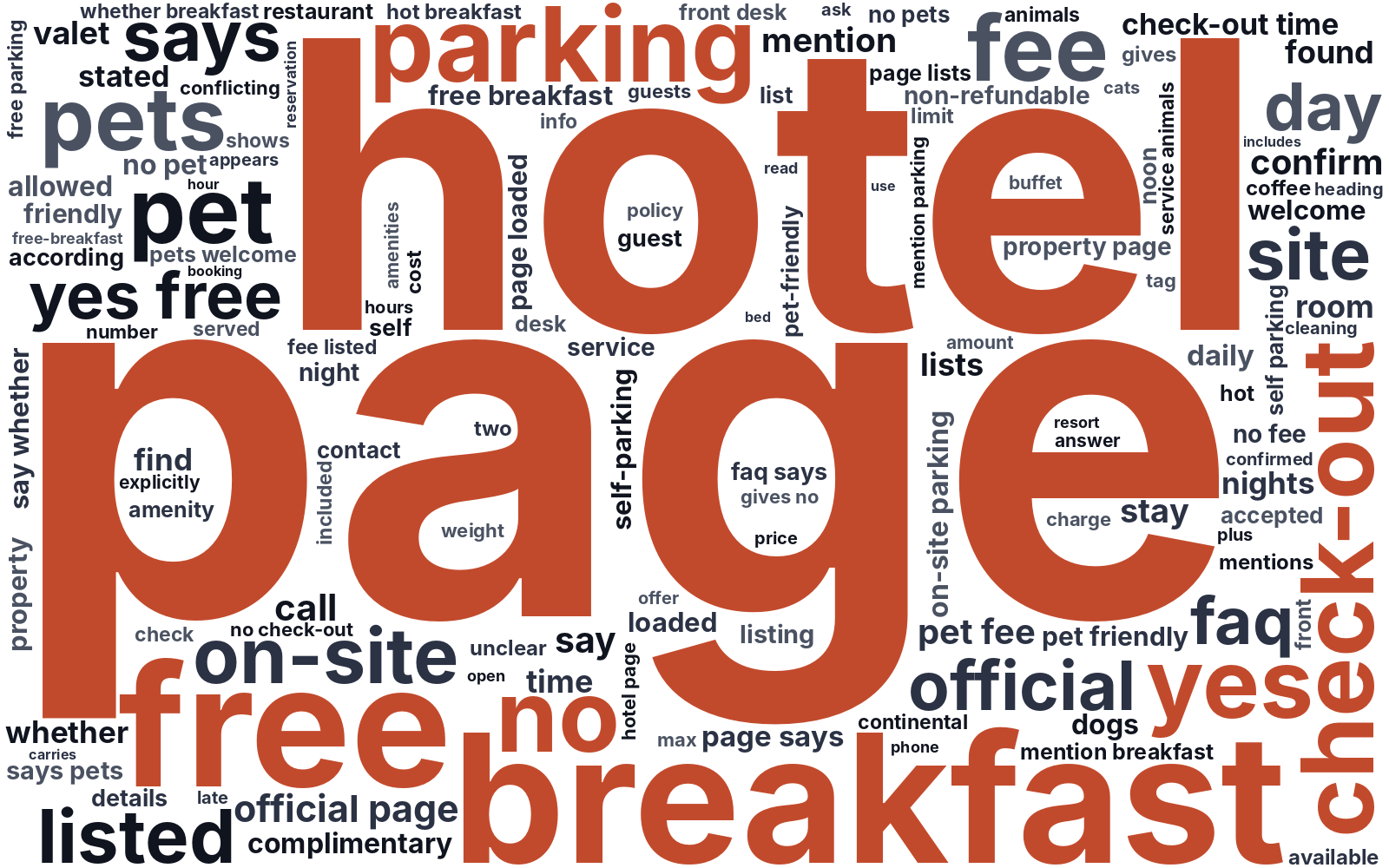
Word cloud of the study seats' own answers. Largest words: page, hotel, breakfast, free, parking, no, check-out, yes, pet, fee.
From the answers the study's own AI sessions gave
Free download

The checklist the AIs wrote.

We asked the AIs that searched for these hotels what would have made the answer easy to find. Their list covers what to fix and how to give an AI a reason to pick you.

Email delivery of the checklist is not available yet. This form cannot accept email addresses.

Part 8

Check our work.

Short on time? Give this page and the data files to your AI assistant and ask it your questions.

Everything we did, documented as we did it, so anyone or their AI can repeat it. The data files behind each table are published alongside this piece with hotel names replaced by market, chain scale and brand family. Chain scale follows STR's public chain-scale list. Hotel names, dates and lengths of stay are available on request to the brand concerned; we don't publish them, and we don't name a hotel in any version.

When.

Every study run was on Friday, October 23, 2026, Mountain Time; the recheck described below ran on November 14. The connector check searched the nights of November 10 to 11, 2026, with November 17 to 18 as a second try for two hotels.

The sample.

200 hotels across North America, 50 each in four categories: city center, suburban, rural and resort. Branded and independent hotels in each. Codex built the list on October 22, 2026, from public web searches, spreading each category across chain scale (economy to luxury), affiliation (independent, soft brand, fully branded) and country (140 US, 30 Canada, 30 Mexico), and choosing by that spread, not by any hotel's reputation. Each was checked by a script against its official URL 14 ways, one of which presented itself as an ordinary browser. The script ran no AI model.

Group A, 65 hotels.

Denied or challenged on all 14 checks, including the browser check. 49 fully branded, 16 soft-brand collections, 0 independent. All 44 independents in the 200 are in the other 135. Bot-protection vendor markers seen on the 65: Akamai 42, Cloudflare plus DataDome 14, Cloudflare only 2, none recorded 7. A marker doesn't prove the cause, and we don't claim it does.

The 80-hotel test list.

Another 14 of the 200 didn't block all 14 checks, but didn't give any check a readable page either: all 10 Choice hotels and 2 other branded hotels hit a connection error on every check, one independent challenged 11 checks and answered the other 3 with “payment required,” and one independent redirected every check without serving a page. The 65 in Group A, plus 15 controls from the other 135: 5 Wyndham, 5 Choice, 5 independent. By brand family: Marriott 19, Best Western 14, Hilton 9, IHG 9, Hyatt 7, Wyndham 5, Choice 5, independent 5, Four Seasons 4, other branded 3 (one Red Roof, one Peninsula, one IHG resort on its own domain). By country: 56 US, 13 Mexico, 11 Canada.

The questions, exactly as asked.
  1. What time is check-out at [hotel]?
  2. Does [hotel] include free breakfast?
  3. How much is parking at [hotel], and is it on site?
  4. Is [hotel] pet friendly, and what's the fee?
  5. (Approved, not yet run.) I'm flying out of [nearest airport] at 7 pm. Which hotels near [neighborhood] have at least a noon check-out?

For the consumer-chat screenshot run, the wording was: "What time is check-out at [hotel] in [city]? Please check the hotel's own website if you can."

What counts as an answer.

A specific time, amount or yes-or-no that the assistant stated, with the source it gave. "Partial" means the assistant gave an answer with a stated conflict or missing piece (for example a fee with no on-site confirmation, or a tag that contradicts the FAQ). "None" means it said it couldn't find one. We record where the answer came from: the hotel's or brand's own site, a booking site, other, or none. When an assistant said it couldn't read the hotel's page, we record that it said so. We do not record why a page didn't answer, and we don't speculate about it here.

Round 1: check-out, Claude, all 80.

Question 1, asked plainly, with Claude also opening the hotel's official URL directly. Claude read the time off the hotel's own page for 51 of the 65 in Group A: Marriott 19 of 19, Best Western 14 of 14, IHG 9 of 9, Hilton 8 of 9, Red Roof 1 of 1, Hyatt 0 of 7, Four Seasons 0 of 4, Peninsula 0 of 1, the IHG resort on its own domain 0 of 1. Controls: 6 of 15. Choice 5 of 5, Wyndham 0 of 5, independents 1 of 5. Claude's page reader summarizes what it sees, so "no time on the page" means it didn't find one, not proof that none exists.

Where Claude's notes say whether the hotel's own page came up in its search, it was missing 31 times out of 40 and came up 9 times; 3 more notes mention the search without saying, and the rest of the 80 have no note on it (the search_note column in claude_checkout). For nine hotels, Claude's notes say search surfaced no link to the hotel's own site, so Round 1 then opened the address from our list.

Claude read the page at the address it was given. For six hotels more than one address was opened: a second page from search, a redirect, or once a link from the home page to its FAQ. On one Hilton page, the Hotel Info page it pointed to was not opened, because it was not the address given.

Round 1: check-out, OpenAI search through Codex, all 80.

Same question. It gave a time for all 80. It read the hotel's official page for 73 of 80, including 62 of the 65 in Group A, and for 20 the time came from a search result. It worked from OpenAI's stored copy of the web, not live page fetches, and in several cases (Hyatt and Wyndham among them) the time came from a search-result snippet after the page itself couldn't be read. By family: Marriott 18 of 19, Best Western 13 of 14, IHG 9 of 9, Hilton 9 of 9, Hyatt 6 of 7, Four Seasons 4 of 4, other Group A 3 of 3, Choice 4 of 5, Wyndham 4 of 5, independents 3 of 5 (official page read).

Screenshot run: consumer chats, 8 hotels.

ChatGPT, Gemini and Claude, each asked once per hotel in an ordinary signed-in consumer session on a Mac, with a screenshot of every answer (213 screenshots on file). The 8: a Phoenix midscale Best Western; a Denver upper midscale IHG; a Baltimore midscale Hilton; a Dallas upper upscale Marriott soft-brand hotel; a New York luxury Four Seasons; a Denver luxury Hyatt; a Chicago economy Wyndham (control); a Des Moines economy Choice hotel (control). Results: every assistant gave a time for all 8. Cited the hotel's or brand's own site: ChatGPT 8 of 8, Gemini 6 of 8, Claude 4 of 8. Claude said it couldn't reach the hotel's own page for 5 of 8 (Best Western, Hilton, Hyatt, Wyndham, and on the Marriott it said the hotel's own site didn't come up in search, so it used Marriott's page). Counting only answers whose time came from the hotel's or brand's page: ChatGPT 7 of 8, Claude 3 of 8. Siri was planned and did not run.

Round 2: breakfast, parking, pets, Claude, all 80.

Questions 2 to 4, 240 asks. Specific 122, partial 63, none 55. Counted by where the answer came from: a specific answer from the hotel’s own page 110 (46%), vague or not from the hotel’s own page 75 (31%), nothing 55 (23%). Source: hotel or brand site 178, booking site 10, other 4, none 48. A plain "no" (no pets, no free breakfast) counts as a specific answer. An answer with a stated conflict on the page (two parking rates, two pet fees) counts as partial. By family (specific answers from the hotel's or brand's own page, breakfast / parking / pets): Marriott 6/19, 15/19, 17/19. Best Western 11/14, 2/14, 2/14. IHG 3/9, 5/9, 8/9. Hilton 5/9, 4/9, 5/9. Hyatt 2/7, 0/7, 6/7 (the main pages of 4 Hyatt hotels refused Claude on all three questions; for three of them, breakfast and parking came from booking sites and pets came from Hyatt's own policies pages). Four Seasons 0/4, 0/4, 0/4. Choice 4/5, 1/5, 5/5. Wyndham 4/5, 1/5, 0/5. Independents 1/5, 1/5, 1/5. Red Roof 0/1, 0/1, 1/1. The Peninsula and the IHG resort 0 on all three. That is 110 of 240.

Connector check: 8 hotels, question 1, inside Claude.

Connectors turned on: Expedia, Booking.com, Hilton, Wyndham, Accor, Tripadvisor, Trivago, lastminute.com. Hilton answered its hotel in 1 call; Wyndham answered its hotel in 2 calls; Booking.com answered 7 of 8: 6 in 2 calls each (search, then property Q&A) and the Dallas Marriott in 3, because it was missing on the first dates; Booking.com never returned the Des Moines Choice hotel on either date pair. Expedia and Trivago returned price and rating only. Tripadvisor returned details with an empty policies field for 3 of 3 tried. lastminute.com resolved "Denver" to Denver, United Kingdom. Accor was not applicable; Choice and Hyatt have no Claude connector. None of these connectors required a sign-in. DirectBooker has a Claude connector and was left out because its terms don't permit this kind of benchmarking without an agreement.

Who uses which assistant.

Two public measures, both from mid-2026. Share of AI assistant users across apps and the web (Sensor Tower, through May 2026): ChatGPT 46.4%, Gemini 27.7%, Claude 10.3%, every other assistant under 5%. Web referrals (StatCounter, June 2026): ChatGPT about three in four, then Gemini, Perplexity, Claude and Copilot; the exact figures are in the notes at the foot of the page. We tested ChatGPT, Gemini and Claude. We did not test Perplexity, Copilot or Siri.

How the brands were scored.

Six measures, each yes or no: the share of the brand's hotels in the 200 where at least one of the 14 first-pass checks got a readable page; Claude read check-out from the hotel's own page; and the hotel's own page gave a specific answer on breakfast, on parking and on pets; plus whether the brand has its own connector in Claude. A brand's score is the average of its six measures, out of 100. In the first pass, 10 of 29 Marriott hotels let at least one check in (5 of 24 on marriott.com and all 5 on ritzcarlton.com), and Best Western, IHG and Hyatt each had one hotel on its own website that got through. All 10 Choice hotels gave no readable page to any check on October 23, with a connection error rather than a denial. On November 14 we ran the same 14 checks again on those 14 hotels, once as on October 23 and once forcing an older connection type: every Choice hotel denied all 14 both times, the 2 other branded hotels still gave no readable page, one independent still redirected, and the independent that had challenged us served a readable page to 6 of the 14 checks on the older connection. Scores by measure (site open / check-out / breakfast / parking / pets / connector): Hilton 0/89/56/44/56/100 (57); Marriott 34/100/32/79/89/0 (56); Choice 0/100/80/20/100/0 (50); Wyndham 100/0/80/20/0/100 (50); IHG 9/100/33/56/89/0 (48); Best Western 7/100/79/14/14/0 (36); independents 95/20/20/20/20/0 (29); Hyatt 13/0/29/0/86/0 (21); Four Seasons 0/0/0/0/0/0 (0). The three other branded hotels (a Red Roof, a Peninsula and an IHG resort on its own website) aren't ranked. Hotels behind each bar: Marriott 19, Best Western 14, Hilton 9, IHG 9, Hyatt 7, Choice 5, Wyndham 5, independents 5, Four Seasons 4; for site open, the brand's hotels in the 200: Marriott 29, Wyndham 26, Best Western 15, IHG 11, Choice 10, Hilton 9, Hyatt 8, Four Seasons 4, independents 44. For a brand whose sites kept our checks out, the four page measures (check-out, breakfast, parking, pets) exist only because we handed Claude the address; the chart shows that behind a lock.

Site openCheck-outBreakfastParkingPetsConnector
{{m.name}}{{m.a}}{{m.b}}{{m.c}}{{m.d}}{{m.e}}{{m.f}}
What we did not do.
  • We did not test Siri. It was planned and didn't run.
  • We did not run Gemini across all 80 hotels; Gemini appears only in the 8-hotel screenshot run.
  • We did not run question 5, the context question.
  • We asked each hotel each question once per assistant. We did not repeat asks in fresh sessions, so we can't give you a reliability rate. One run is a snapshot.
  • We checked the brand's page for branded hotels. We did not set out to check separate vanity sites a hotel may have; one search opened one, and it didn’t answer the question.
  • We did not test the ChatGPT apps that Expedia, Booking.com, Accor, Hyatt, Hilton and Wyndham have published, or Google AI Mode's built-in hotel booking.
  • We did not open any hotel site in a real browser to check whether it loads for a person. The study measures what a guest's AI experiences, not what is true about the site.
  • We did not record or compare prices. That is the next piece.
  • We did not check which answer is correct when they disagreed. Where assistants disagreed, the disagreement is what we report.

Files. hotels (the 80, anonymized), first_pass_200, recheck_2026_11_14, claude_checkout, claude_questions, openai_checkout, connector-check, screenshot_run. Claude’s answer files carry the question, the answer as given, the source type and whether Claude said it couldn't read the page; the OpenAI file records whether it read the hotel’s official page, and the screenshot file whether each assistant cited the hotel or brand and said it couldn't get in. The first-pass file has every one of the 200 hotels, by brand family: whether it blocked all 14 checks, gave no readable page, or gave a readable page, with how many of its 14 checks were denied or challenged, got a page, or got neither, and what the browser-style check got. The consumer-chat screenshots go to the brand concerned on request, like the hotel names.

{{f.f}}
{{f.t}}
Download ↓
All eight files
ZIP ↓
Part 9

For your assistant.

Hand this to your own AI in a fresh session, the way a guest would ask: no hotel named yet. If it has a memory of you, tell it not to use it. Then do it again next month.

At a full-service hotel, have each department head do the same with their own department's questions, each in their own fresh chat, without the hotel's name.

Prompt 1

Act as if you know nothing about me or my business. Don't use anything from our past conversations or your memory of me. A traveler just asked you these questions, one at a time:

  1. I'm flying out of [nearest airport] at 7 pm. Which hotels near [neighborhood] have at least a noon check-out?
  2. Where should I stay in [city] for a [conference / weekend / family trip]?

Answer each the way you would for a stranger, using only what you can find right now, and tell me which sources you used.

Did your hotel come up? If not, how narrow does the question have to get before it does? Then name the hotel, in the same fresh session:

Prompt 2

A traveler just asked you these questions, one at a time, about [hotel name] in [city]:

  1. What time is check-out at [hotel]?
  2. Does [hotel] include free breakfast?
  3. How much is parking at [hotel], and is it on site?
  4. Is [hotel] pet friendly, and what's the fee?

Answer each the way you would for a stranger, using only what you can find right now. Then, for each one, tell me: which sources you used, which pages you tried to open and couldn't, and whether the answer came from the hotel's own site or somewhere else. If you have a travel connector or app turned on, tell me whether you used it and how many steps it took.

Prompt 3

What does [hotel]'s own website look like to you? Read it the way you'd read any page for a guest and tell me what's on it and what's missing.

Whatever it says, that's what it's serving to your guests today. Write down what you asked, what it said and when. Ask again in a month. If the answer changed and you didn't change anything, that's the lesson.

The page for AI readersLink pending